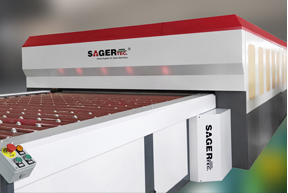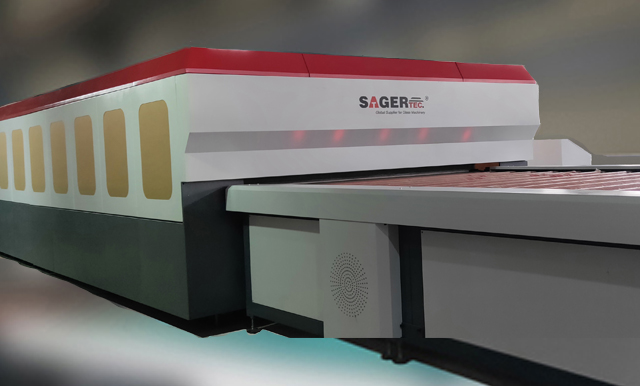
Part 1 of the Sagertec Engineering Series on Laminated Glass Delamination Resistance
A laminated glass panel is not proven only because it looks clear when it leaves a laminated glass line.
Initial transparency confirms that the panel has reached an acceptable visible condition. It does not fully show whether the glass-PVB interface will remain stable after cooling, transport, installation and years of exposure to temperature and humidity.
High-pressure autoclave processing is an established method for PVB laminated glass. It can consolidate a laminate, improve optical contact and reduce visible voids. These are important manufacturing functions.
However, pressure is only one part of the bonding process.
The engineering question that matters most is not simply how much pressure was applied. It is what condition remained at the interface after air removal, heating, bonding, cooling and the release of temporary manufacturing forces.
At Sagertec, this distinction is central to the design of a non-autoclave laminated glass line.
Finished laminated glass should always be inspected for bubbles, haze, contamination, edge defects and optical distortion.
These checks are essential, but they describe the panel at one moment in time.
A clear laminate may still contain conditions that are not visible during an ordinary factory inspection, including:
· localized moisture or volatile content;
· incomplete or interrupted de-airing;
· non-uniform adhesion;
· incompatible glass contours;
· an interlayer build that does not suit the actual glass geometry;
· non-uniform thermal history;
· residual stress near an edge or corner.
International durability testing reflects this difference between initial appearance and environmental performance. ISO 12543-4:2021 evaluates laminated glass resistance to high temperature, humidity and radiation rather than relying only on the appearance of a newly produced panel.
Optical quality is therefore a necessary production checkpoint. It is not, by itself, proof of long-term delamination resistance.
A complete glass laminating line may include loading, washing, drying, positioning, interlayer handling, lay-up, air removal, heating, bonding, cooling, unloading and inspection.
Each stage affects the next one.
The glass surface must be clean, dry and suitable for bonding before lay-up.
Dust, oil, fingerprints, detergent residue, polishing material or water left on the surface can create localized differences in adhesion. A laminated glass furnace cannot reliably correct a bonding surface that was already unsuitable before heating began.
The washing section should therefore be evaluated according to water quality, brush condition, detergent control, drying performance and protection against secondary contamination.
PVB should be stored, conditioned and handled according to the requirements of the selected interlayer.
Packaging condition, exposure time, workshop environment, contamination and material history may all influence processing behavior. A laminated glass machine cannot fully compensate for an interlayer that has already moved outside its suitable handling condition.
Two panes may each be acceptable when measured separately but still be poorly matched when assembled.
The production line should consider the combined geometry of the pair, including bow direction, warp, roller wave, local edge lift and the resulting gap pattern. Interlayer type and thickness should be selected for the actual construction rather than applied as one universal recipe.
Air must have an effective route out of the laminate before the edges seal.
A vacuum value on a control screen does not prove that every area of a large or multilayer panel remains connected to an open evacuation path. The process must coordinate vacuum, temperature, time and material transition so that air and unwanted volatile content can leave before the interface closes.
The relevant temperature is the condition reached by the complete laminate, not only the air temperature inside a glass laminating furnace.
Glass thickness, panel size, coating, interlayer build, load arrangement and airflow can all influence how the product heats. Uniformity must be validated with real constructions, not assumed from one chamber-temperature reading.
Pressure can improve contact between glass and PVB. It can assist consolidation and help suppress visible voids.
Pressure cannot independently:
· clean a contaminated surface;
· restore incorrectly stored PVB;
· reopen an evacuation path that has already sealed;
· make two severely mismatched panes naturally compatible;
· eliminate every form of residual stress;
· guarantee a stable exposed edge;
· replace construction-specific testing.
A high pressure value is therefore evidence of one equipment capability. It is not a complete measurement of interface quality.
Tempered and heat-strengthened glass is not always perfectly flat. Bow, warp and roller-wave distortion can create a geometrical mismatch between two plies.
Under high external pressure, the panes can be forced toward a common shape. The interlayer fills the remaining space, and the panel may appear clear after production.
However, the original difference in shape has not necessarily disappeared.
After pressure is released, each pane may tend to recover toward its natural geometry. Because the plies are already bonded, part of that recovery force can be carried by the interlayer and the glass-PVB interface.
Depending on the construction, this may contribute to:
· local shear within the interlayer;
· peel-type stress near exposed edges;
· stress concentration at corners;
· time-dependent PVB movement;
· gradual reduction of local adhesion.
Published experimental work has reported that planarity deviations and roller waves in thermally toughened glass can create permanent tensile stress through the thickness of a laminate.
This does not mean that every autoclave laminate contains harmful stress. It means that high pressure can sometimes close a geometry problem during processing without removing its original cause.
A controlled non-autoclave vacuum process has less ability to force severely mismatched glass into an apparently perfect panel.
This can make the process less forgiving, but it can also improve quality control.
When glass flatness is inadequate, pairing is poor, the interlayer build is unsuitable or evacuation is incomplete, the problem may appear during production as an edge gap, corner defect, local bubble or optical variation.
The processor must then correct the actual input by improving:
· glass selection and pairing;
· interlayer construction;
· lay-up cleanliness;
· evacuation continuity;
· heating uniformity;
· cooling and unloading conditions.
At Sagertec, we describe this as early defect visibility.
A defect found inside the factory can be investigated before shipment. A latent defect that becomes visible only after installation is more difficult and costly to manage.
Early visibility is not proof that every non-autoclave laminate will be durable. A poorly controlled vacuum process can also produce weak adhesion and delamination. The advantage exists only when the equipment, materials and process window are correctly matched.
Across production observation, customer feedback and selected internal boil-test screening of documented constructions, Sagertec has observed that properly engineered non-autoclave PVB laminates can demonstrate strong resistance to edge whitening and separation.
We do not attribute this result to low pressure as an isolated feature.
The more useful explanation is that a well-controlled non-autoclave process can:
· keep an evacuation route active during critical stages;
· make incompatible glass geometry more visible;
· require the interlayer build to suit the actual panel;
· reduce dependence on temporary high-pressure compensation;
· place greater emphasis on controlled heating and cooling.
These observations apply to the tested constructions and process conditions. Internal screening does not replace applicable standards, customer qualification or project-specific testing.
When comparing a laminated glass line, glass laminating machine or glass laminating furnace, buyers should ask:
1. Which PVB types and glass constructions have actually been validated?
2. How does the system maintain an effective evacuation path during heating?
3. How is product-temperature uniformity verified?
4. What glass-flatness and pairing rules are recommended?
5. How are cooling and vacuum release controlled?
6. Which production data can be recorded by batch?
7. What test methods support the stated processing range?
These questions reveal more about long-term production capability than a single pressure, vacuum or temperature specification.
The best laminated glass line is not necessarily the system that applies the greatest pressure.
It is the system that can repeatedly leave the glass-interlayer interface in a stable condition after temporary manufacturing forces have disappeared.
Long-term PVB laminated glass durability depends on the combined control of glass cleanliness, interlayer condition, air removal, thermal uniformity, glass geometry, cooling, residual stress and edge exposure.
Pressure can support the process, but pressure cannot replace the process.
For Sagertec, non-autoclave PVB lamination is built around this interface-first engineering principle.
No. Higher pressure can improve contact and consolidation, but durable adhesion also depends on surface condition, PVB handling, moisture, evacuation, temperature history, glass geometry, cooling and residual stress.
No. The glass, interlayer, equipment and process settings must be compatible and validated. A controlled non-autoclave process can reduce certain latent risks, but vacuum alone is not a quality guarantee.
There is no single factor. Buyers should evaluate how the complete line coordinates glass preparation, material handling, evacuation, product heating, cooling, data traceability and finished-product testing.