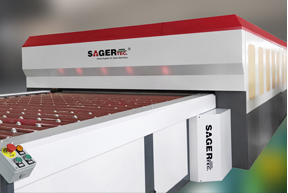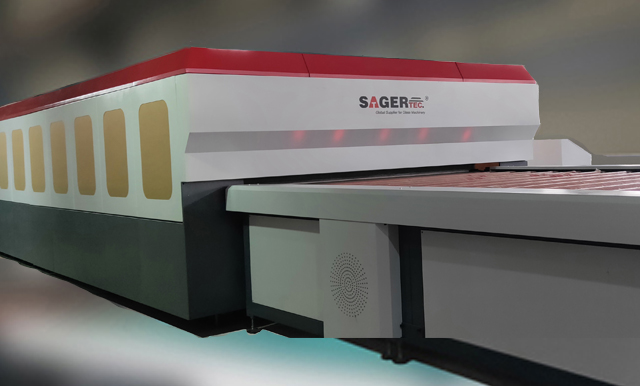
August 2026 — Sagertec is currently installing and commissioning an SG-3000-4SD glass laminating oven at the facility of a returning customer in the United Kingdom. The customer previously purchased an SG-3000-1DD and has now selected the higher-capacity, dual-chamber SG-3000-4SD as its laminated glass business and production requirements continue to grow.
This repeat order represents more than another equipment delivery. It is the next stage of a customer relationship that began with the earlier SG-3000-1DD installation and has developed through practical production experience. As the customer’s needs evolved, the new investment was chosen to provide greater batch capacity, more flexible production scheduling and additional room for future expansion.
Selecting a glass laminating oven is an important production decision. A glass processor must consider not only maximum glass size and installed power, but also order mix, daily workload, loading flexibility, process control and the ability to respond to future demand.
The SG-3000-1DD was purchased for the customer’s earlier production requirements. With the continued development of its business, the company required a more capable system for handling a higher workload and organising different batches more efficiently. It therefore returned to Sagertec and selected the SG-3000-4SD.
The move from the SG-3000-1DD to the SG-3000-4SD is a capacity expansion rather than a simple change of model number. The new machine introduces a dual-chamber architecture and up to four vacuum-bag loading positions, giving the customer more ways to match furnace use to the actual order schedule.
Actual output will always depend on glass dimensions, laminate construction, loading quantity, interlayer specification and the validated process recipe. The value of the SG-3000-4SD lies not only in its higher potential batch capacity, but also in the flexibility with which that capacity can be used.
The SG-3000-4SD glass laminating furnace is designed with two separately operated heating chambers. Each chamber can accommodate up to two silicone vacuum bags, allowing production to be arranged according to the workload:
One vacuum-bag load in a single chamber for a small order
Two loads in one chamber for a larger batch
Three or four loads using both chambers when more capacity is required
Because the two chambers can be operated independently, the customer does not need to use the full installed capacity for every production cycle. One chamber can serve smaller batches, while both chambers can be used during busier periods. This helps the production team respond to changing order quantities without giving up the ability to handle higher-volume work.
The machine uses Siemens PLC control with a touchscreen interface, together with PID temperature regulation and recipe-based process management. Operators can set and monitor the principal lamination parameters, save production recipes and recall approved settings for repeat orders. Adjustable forced-air circulation supports balanced heat transfer throughout the processing area.
Stable control of vacuum, temperature and time is essential in vacuum-bag glass lamination. The correct cycle must therefore be selected for the glass construction, total thickness, loading condition and interlayer being processed. This process-led approach helps the customer move from individual trial settings toward repeatable day-to-day production.
Installation and commissioning are now underway at the customer’s UK facility. This stage ensures that the glass laminating oven is correctly connected, checked and prepared for the customer’s intended production conditions.
The commissioning work covers the main mechanical and electrical checks, utility connections, vacuum operation, heating and temperature control, PLC and touchscreen functions, operating and safety functions, and trial production cycles. Operator instruction is also an important part of the process, including machine operation, recipe selection, routine inspection and basic maintenance.
Process settings are reviewed against the actual glass constructions, interlayers and loading arrangements that the customer plans to use. This is important because the performance of any EVA glass laminating furnace depends on the complete process—not on furnace temperature alone.
At the time of publication, the installation and commissioning work remains in progress. The machine will move into regular production after the required checks, test cycles and operator preparation have been completed.
The SG-3000-4SD is primarily designed for vacuum-bag production of EVA laminated glass. With suitable materials and validated process settings, it can support architectural and interior safety glass, decorative laminated glass and selected functional products.
Possible applications include glass doors, partitions, balustrades, canopies, furniture glass and decorative constructions incorporating compatible fabrics, printed designs, coloured films, metal mesh or other heat-compatible inserts. With suitable EVA and functional films, the equipment may also be configured for selected privacy-glass and switchable-glass applications.
Every new interlayer, insert and laminate construction should be evaluated before routine production. Final glass products must also meet the standards and project requirements applicable to their intended use.
Terminology varies across international markets. Buyers may refer to this equipment as a glass laminating oven, glass laminating furnace, glass lamination furnace, laminated glass oven or laminated glass furnace. These expressions can describe broadly similar batch equipment that uses controlled vacuum and heat to bond glass with an interlayer, although the chamber design, heating method, vacuum arrangement and level of automation may differ significantly.
A glass laminating line or laminated glass line, however, normally describes a wider production system. Depending on its automation level, a complete line may include glass loading, washing and drying, interlayer preparation, glass assembly, transfer, lamination, cooling and unloading.
The SG-3000-4SD is the batch lamination unit, not a complete production line by itself. Within a broader factory workflow, it can serve as the central thermal-processing stage alongside the customer’s glass preparation, assembly, handling and inspection operations. For processors that require a more highly integrated production system, Sagertec also supplies dedicated automatic PVB glass laminating line solutions.
For Sagertec, the most meaningful aspect of this UK project is that the customer chose to invest in our equipment again after operating its earlier SG-3000-1DD. The repeat order continues an established working relationship and gives both teams a practical basis for planning the next stage of production.
Customer requirements rarely remain fixed. Order volumes increase, product mixes change and new applications create different demands on capacity and process control. By understanding the customer’s existing equipment and operating experience, Sagertec can recommend an expansion based on actual production needs rather than a one-size-fits-all specification.
The SG-3000-4SD installation demonstrates this step-by-step approach: begin with equipment suited to the current operation, then expand capacity and flexibility as the business develops.
If your current glass laminating oven is approaching its production limit, tell us your maximum glass size, typical glass construction, interlayer type, target output, available utilities and existing production workflow. Our team can recommend a suitable glass laminating furnace or, where required, a complete laminated glass production-line configuration.
Contact Sagertec to discuss your project and request a suitable equipment configuration.