
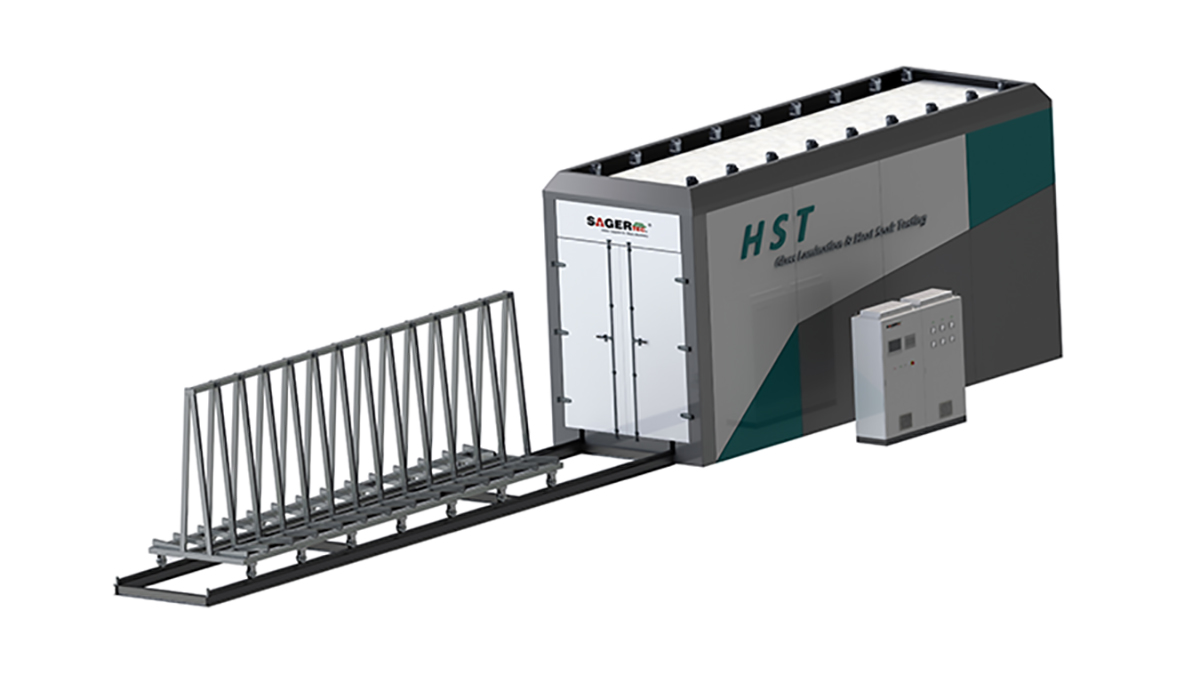
Tempered Glass Heat Soak Test Furnace – HST System
Reduce the Risk of Spontaneous Breakage in Tempered Glass
Tempered glass—also known as toughened glass—can occasionally break without an obvious external impact. One of the best-known causes is the presence of critical nickel sulfide inclusions inside the glass.
A heat soak test furnace provides a controlled post-tempering process designed to accelerate the transformation of potentially critical nickel sulfide inclusions. Glass panes containing inclusions capable of causing failure are encouraged to break safely inside the furnace rather than after installation in a building.
By reducing the residual risk of NiS-related spontaneous breakage, heat soak testing improves confidence in tempered glass used for façades, curtain walls, canopies, balustrades, overhead glazing and other safety-critical architectural applications.
Why Can Tempered Glass Break Spontaneously?
Nickel sulfide inclusions can originate during the glass manufacturing process. Although these inclusions are extremely small, some may create a delayed breakage risk after the glass has been thermally toughened.
During tempering, the glass is heated to a high temperature and then rapidly cooled. At the elevated temperature, nickel sulfide can exist in a high-temperature crystalline phase. Rapid quenching may not provide sufficient time for it to return fully to its stable low-temperature phase.
The remaining phase transformation can then continue slowly after the glass has been installed. Because the low-temperature phase occupies a larger volume, the transformation creates localized stress around the inclusion.
If the inclusion is sufficiently large and located within a critical tensile-stress region of the glass, the resulting stress can initiate a crack and cause the entire tempered pane to break.
How Heat Soak Testing Works
The heat soak test accelerates the phase transformation under controlled furnace conditions.
1. Glass Loading
After tempering, the glass panes are placed vertically on loading racks with appropriate spacing for air circulation and temperature uniformity.
2. Controlled Heating
The furnace gradually heats the glass according to the selected process recipe. Multiple temperature sensors monitor conditions at different locations within the load.
3. Temperature Holding
Once the required glass temperature has been reached, the furnace maintains the specified holding conditions.
This elevated-temperature stage accelerates the transformation of potentially critical nickel sulfide inclusions. Glass containing inclusions capable of generating sufficient internal stress may break inside the protected furnace chamber.
4. Controlled Cooling
After the holding stage, the furnace cools the glass according to the programmed process curve. Controlled cooling protects the remaining glass and prepares it for safe unloading.
5. Process Documentation
Temperature curves and relevant cycle data are stored by the control system. Production records can subsequently be reviewed and printed for internal quality control, customer documentation and process verification.
Computer-Controlled Heat Soak Process
The furnace uses a computer-based monitoring and control system to manage the complete heat soak test cycle.
The operator can configure and monitor:
- Heating stages
- Target temperatures
- Holding time
- Cooling stages
- Temperature curves
- Process status
- Stored test records
Once the selected program has started, the control system automatically executes the programmed process stages.
This reduces dependence on continuous manual adjustment and helps maintain repeatable testing conditions across different operators, production shifts and load quantities.
Multi-Channel Temperature Monitoring
Multiple temperature curves can be displayed simultaneously during the heat soak process.
This allows the operator to observe temperature development at different monitoring points and verify that the glass load is progressing through the programmed cycle as intended.
Clear curve visualization helps identify:
- Heating differences within the load
- Delayed temperature response
- Unusual process deviations
- Completion of the required heating stage
- Stability during the holding period
- Cooling progress
The number and arrangement of temperature-monitoring points can be customized according to the furnace dimensions, loading structure and applicable process requirements.
Complete Process Traceability
Reliable documentation is essential for professional heat soak testing.
The control system provides:
- Real-time temperature-curve display
- Automatic process-data recording
- Historical record storage
- Previous-cycle review
- Temperature-curve retrieval
- Test-record printing
- Exportable production documentation, subject to configuration
These functions help glass processors demonstrate that each load has completed the programmed HST cycle and provide traceable records for quality-management systems, customers and third-party verification.
Designed to Support EN 14179-1 Production
The furnace can be designed, configured and calibrated to support heat soak production in accordance with EN 14179-1:2016 and corresponding national versions such as DIN EN 14179-1 and BS EN 14179-1.
EN 14179-1 covers heat-soaked thermally toughened soda-lime silicate safety glass for use in buildings and specifies requirements relating to the heat soak process system and finished glass.
Compliance depends not only on the furnace itself, but also on:
- Correct furnace configuration
- Temperature uniformity
- Sensor arrangement
- Calibration
- Loading method
- Process settings
- Operating procedures
- Production documentation
- Applicable factory production control
The furnace and control system can be prepared for independent third-party calibration and process validation according to the customer’s target market and certification requirements.
Independent Calibration Experience
In a recent UK customer project, our heat soak test furnace underwent independent third-party calibration under both 100% full-load and 10% load conditions to support EN 14179-1 production.
Testing at different load levels provides valuable evidence that the furnace can maintain controlled and traceable process conditions across realistic production scenarios.
Key Features and Advantages
Automatic Heating, Holding and Cooling Control
The computer-controlled system automatically executes the complete programmed cycle, reducing operator intervention and supporting repeatable HST production.
Multiple Temperature-Curve Display
Several monitoring curves can be viewed simultaneously, giving operators a clear picture of temperature development throughout the furnace and glass load.
Data Storage and Record Review
Complete cycle records can be stored and retrieved for quality control, troubleshooting, customer documentation and production audits.
Curve and Report Printing
Recorded temperature curves can be printed or exported, depending on the selected control configuration.
Customizable Monitoring System
The number and location of temperature sensors can be designed according to furnace size, glass-loading arrangement and process requirements.
Customized Chamber and Loading Capacity
The furnace can be manufactured according to the customer’s:
- Maximum glass size
- Required loading capacity
- Glass rack dimensions
- Factory space
- Production volume
- Loading and unloading method
Customized Electrical Configuration
Voltage, frequency, installed power and electrical components can be configured according to the customer’s local power supply and project requirements.
Industrial Process Reliability
The heating, circulation, insulation and control systems are engineered for repeated industrial heat soak cycles and stable long-term production.
Applications
The heat soak testing furnace is suitable for tempered or toughened glass used in:
- Architectural façades
- Curtain-wall systems
- Overhead glazing
- Glass canopies
- Balustrades and railings
- Glass doors
- Interior and exterior partitions
- Large commercial buildings
- Public buildings
- Transport facilities
- Other safety-critical glazing applications
Heat soak testing is particularly valuable when spontaneous breakage after installation could create safety risks, replacement costs, access difficulties or damage to surrounding building components.
Optional Multi-Purpose Furnace Functions
With suitable hardware and control-program modifications, the furnace can also be configured for selected low-temperature industrial glass processes, including:
- Glass drying
- Low-temperature heating
- Process preheating
- Pre-pressing of bent laminated glass
- Other customized thermal processes
These optional functions are separate from the standardized heat soak test cycle and should be configured according to the customer’s specific process requirements.
General Technical Configuration
| Item | Specification |
|---|---|
| Equipment Type | Tempered glass heat soak test furnace |
| Common Name | HST furnace / glass heat soak furnace / heat soak test oven |
| Primary Application | Post-tempering heat soak testing |
| Glass Type | Thermally toughened/tempered glass |
| Reference Standard | EN 14179-1:2016 or specified local standard |
| Process Control | Computer-controlled heating, holding and cooling |
| Temperature Monitoring | Multi-channel temperature-curve display |
| Data Functions | Storage, historical review and curve printing |
| Chamber Size | Customized |
| Maximum Glass Size | Customized |
| Loading Capacity | Customized |
| Glass Rack Configuration | Customized |
| Sensor Quantity and Layout | Customized |
| Voltage and Frequency | Customized |
| Installed Power | Customized |
| Data Export | Available according to control configuration |
| Third-Party Calibration | Supported according to project requirements |
| Optional Functions | Drying, low-temperature heating and curved laminated-glass pre-pressing |
FAQ – Tempered Glass Heat Soak Test Furnace
1. What is a heat soak test furnace?
A heat soak test furnace is a post-tempering thermal testing system used to reduce the risk of spontaneous breakage caused by critical nickel sulfide inclusions in tempered glass.
It may also be called a glass heat soak furnace, heat soak testing furnace, HST furnace, toughened glass heat soak oven or heat soak testing machine.
2. What causes NiS-related spontaneous breakage?
During tempering, nickel sulfide inclusions may be retained in an unstable high-temperature phase. Their gradual transformation to a stable low-temperature phase is accompanied by volume expansion.
If a critical inclusion is located in a highly stressed region of the glass, this expansion can generate enough localized stress to cause spontaneous breakage.
3. How does a heat soak test reduce the risk?
The HST process heats tempered glass under controlled conditions, accelerating the nickel sulfide phase transformation.
Glass containing critical inclusions is more likely to break safely inside the furnace, reducing the residual risk of NiS-related breakage after installation.
4. Does the furnace support EN 14179-1?
The furnace can be designed, configured and calibrated to support production in accordance with EN 14179-1:2016.
Final conformity depends on furnace calibration, sensor arrangement, loading procedures, process control, documentation and the glass processor’s factory production system.
5. What process data can be recorded?
Depending on the selected control configuration, the system can record and store multiple temperature curves, process times, cycle history and other relevant production data.
Records can be reviewed and printed for quality control and customer documentation.
6. Can the furnace size be customized?
Yes. Chamber dimensions, loading capacity, glass racks, heating power, sensor arrangement, voltage and control functions can be customized according to the customer’s glass sizes and production requirements.
7. Does heat soak testing eliminate all future glass breakage?
Heat soak testing substantially reduces the residual risk associated with critical nickel sulfide inclusions, but it cannot guarantee that no glass pane will ever break.
Other causes—such as edge damage, installation stress, impact, thermal stress or different glass defects—are separate from the NiS heat soak process.
8. What information is required for a quotation?
Please provide:
- Maximum glass dimensions
- Glass thickness range
- Required loading capacity
- Typical daily production
- Glass rack dimensions
- Applicable testing standard
- Required temperature-monitoring points
- Data storage and reporting requirements
- Available factory space
- Local voltage and frequency
Based on this information, we can develop a customized furnace layout, technical specification and quotation.